
When diversity isn’t enough
A conversation with Yolanda Rother on DEI and what real inclusion requires.

Inclusion is often treated as a goal, but in reality, it remains an open question, one that reveals who is truly seen, considered, and included. In Germany, where the Afrozensus estimates that over one million people of African origin live in the country. Everyday experiences from beauty aisles to workplaces, still reflect a gap between presence and representation. In this conversation with Yolanda, we explore how these gaps are rooted in deeper systems, and what it really takes to build meaningful, lasting inclusion.
Introduce yourself and tell us a bit about your work.
I am a founder of The Impact Company, a diversity and inclusion (DEI) consulting firm.
We work together with brands, corporates, nonprofits, all different types of organisations to help them become more inclusive. Whether that’s their work processes, how they’re paying people, how they’re making their decision-making, or when they’re looking at producing products.
What are the most common challenges that you see when guiding companies on questions of diversity and inclusion?
Diversity and inclusion, or DEI, has been around for a bit. In 2020, after BLM protests, companies were looking to take a stand on racism & discrimination. What we saw were a lot of workshops, keynotes, and the beginning of measures. The challenge is that fighting racism isn’t a one-off! Ideally, it’s a long term strategy with long term budgets. Instead. The challenge is that some employees get tasked with DEI, just because of their lived reality, or that budgets aren’t available for long-lasting measures.
You used the term DEI quite a lot. Could you explain the term DEI, where it comes from, what it stands for, and what kind of structures are behind it?
DEI stands for diversity, equity, and inclusion. The term itself has been evolving so much.
When it was starting in the 1960s in the United States, DEI was about employment equality. Why? Because of the Civil Rights movement in the United States, race segregation was a reality and so companies were, by law, held accountable to creating workplaces that were fairer.
From that, it’s developed and evolved into diversity, equity, and inclusion. Especially in the 80s, 90s, all the way now to 2020.
Some speak of DEIB: diversity, equity, inclusion, and belonging. The belonging part is this feeling of: I can arrive at a workplace, I can be my full self, I don’t need to keep a form of who I am away or at home, so I feel like I belong.
There’s also DEIA, which looks specifically at diversity, equity, inclusion, and accessibility. So we’re now talking about how we can make workplaces as accessible as possible for people who have an invisible handicap, like neurodivergence or a physical handicap.
There’s also JEDI. J for justice, E for equity, D-I for diversity inclusion, and basically it puts justice to the front. So it’s important that we’ll only be able to achieve equity and diversity inclusion through the justice system.
Some people only speak of D&I, so diversity and inclusion, and leave out the E part. Others speak of EDI, they want to put equity in the front.
And now, the most recent development has been FAIR. We don’t speak about DEI anymore, some people speak about FAIR: fairness, access, inclusion, representation, coined by Lily Zheng.
It’s about outcomes over intentions. It goes away from identity politics, and it’s a really great new thing.
As Bell Hooks likes to say in the beginning of her book ‘“All about Love”, Definitions are vital starting points for the imagination. What we cannot imagine cannot come into being.
A good definition marks our starting point and lets us know where we want to end up.
As we move toward our desired destination we chart the journey, creating a map.
“ So having that shared definition is really critical to know where the journey is going.This is where we find ourselves.
You mentioned that DEI comes from the workplace. So how does a lack of diversity affect employee engagement within businesses and the business itself?
I often feel we shortcut DEI and only speak of diversity, especially in the German context. But the question is really: how does that diverse group feel as part of a larger group? And that’s where the investment needs to come.
In a workplace, usually you’re going to have a lot of diversity there just by the fact that everybody brings their own background. Somebody looks different, somebody has this or that experience, discrimination, sexual orientation, gender expression, all of these aspects lead to diversity.
But the question is: how can these people show up? How can they feel part of it? How can they take part in decision-making?
Take a hospital. You walk into a hospital and you will for sure see a lot of diversity. You’re going to see diversity that represents our society in the hospital staff.
But the higher you go up in the hierarchy, the less diverse it gets.
So the question is: if we’re looking at decision-making and power, who’s at the top making these decisions and are voices missing, some views not represented, then why is that? How can we increase diversity there??
It’s necessary because our societies are becoming more diverse.
If we look at Germany, for instance, about 30% of people have a migration background. If you look at bigger cities like Frankfurt, or Berlin as well, but Frankfurt specifically, around 75% of children under the age of six have a migration background.
So that means we’re seeing a minority-majority shift.
The issue is that the people in decision-making positions don’t represent the people in society. There’s a major gap, a mismatch of what’s actually needed, what is understanding of culture, of perspectives.
And that affects everything: who is ruling, who is making decisions, who holds power versus the rest of society.
Understanding this is key for representation, for how society evolves, for social cohesion, for democracy, and also for better business decisions.
Because from a business perspective, if you keep missing representation like in the hospital example you might design services or systems that don’t reflect what your actual population needs.
You mentioned hospitals, but in my case, my personal experience comes from the beauty industry.
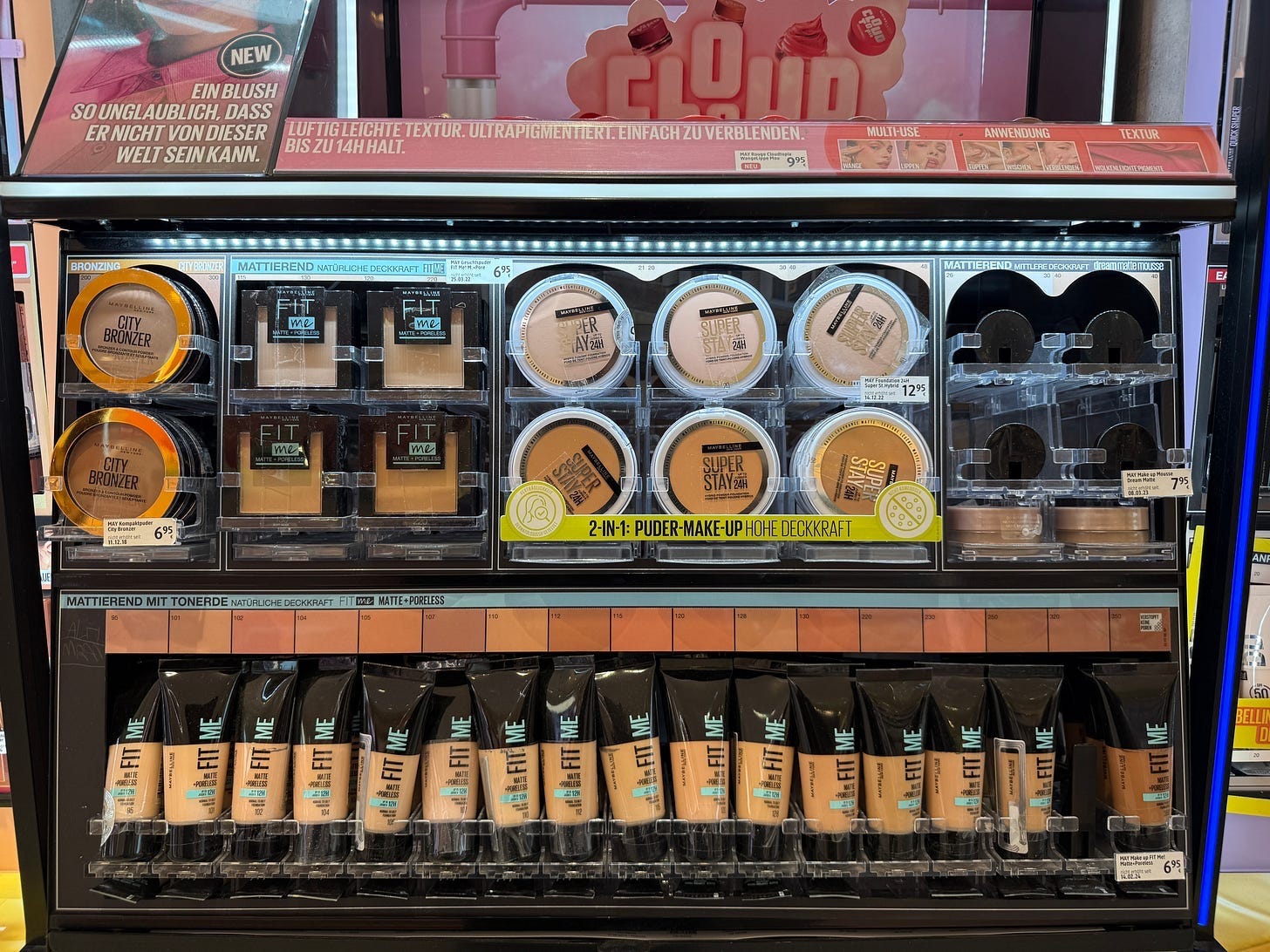
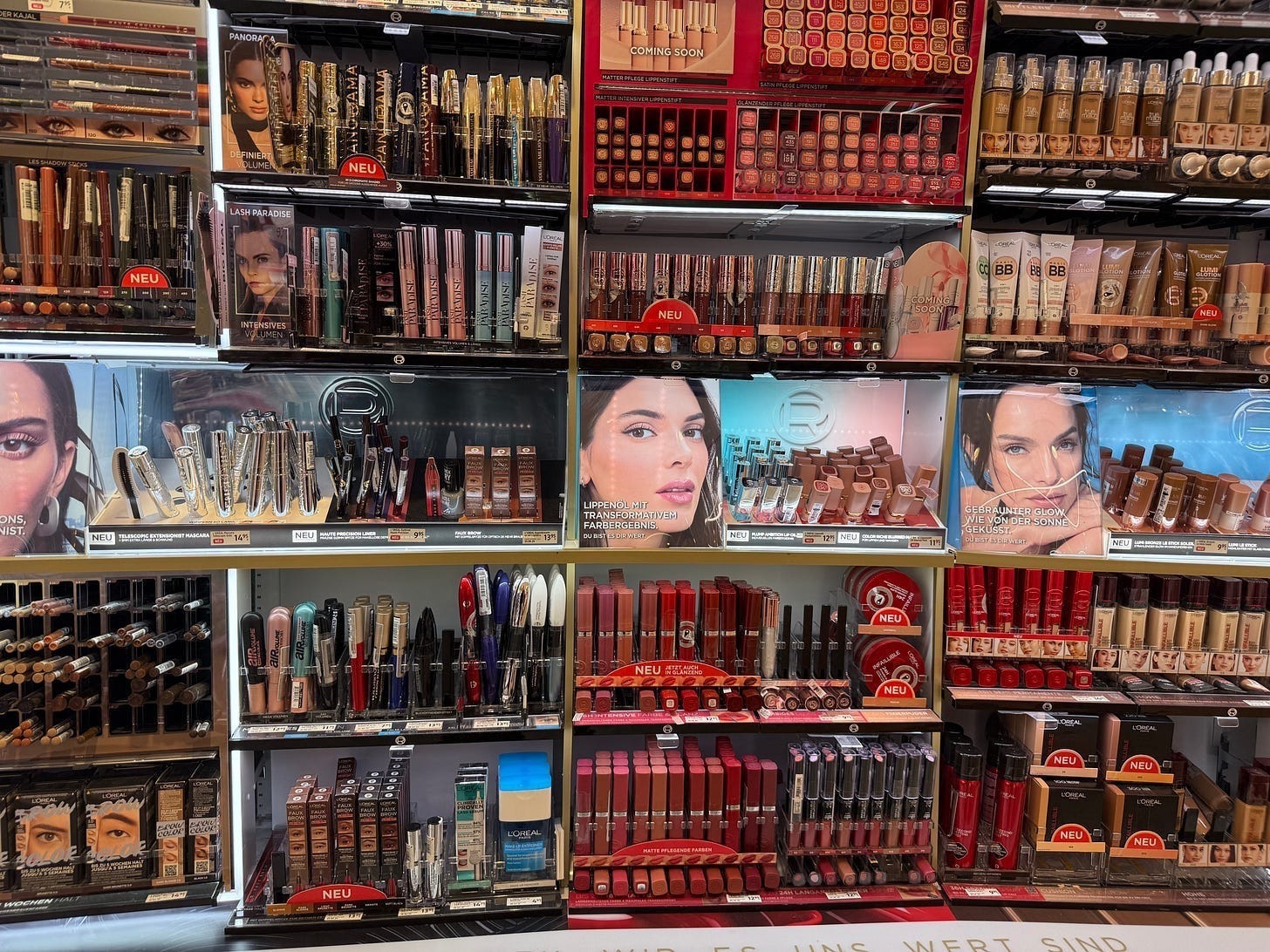
Recently I moved to Berlin, I went to DM and noticed there were very limited options for darker skin tones. I then checked Rossmann, thinking maybe it was just DM, but it was the same.
I even asked a Black woman in the store how she manages buying makeup in Germany, and she told me she doesn’t really buy anymore because there isn’t enough choice.
At the same time, we have around 1.27 million people in Germany with an African migration background. So how do you explain this gap?
You mentioned you moved to Berlin relatively recently, so you’re experiencing something that I’ve been experiencing my whole life.
Going into these stores, whether it’s makeup or hair products, this has been an ongoing issue. And these companies have actually had a history of wrongdoings in their advertising.
They used to portray Afro hair as a “bad hair day,” so there’s a narrative being reproduced about what beauty is and what is considered desirable.
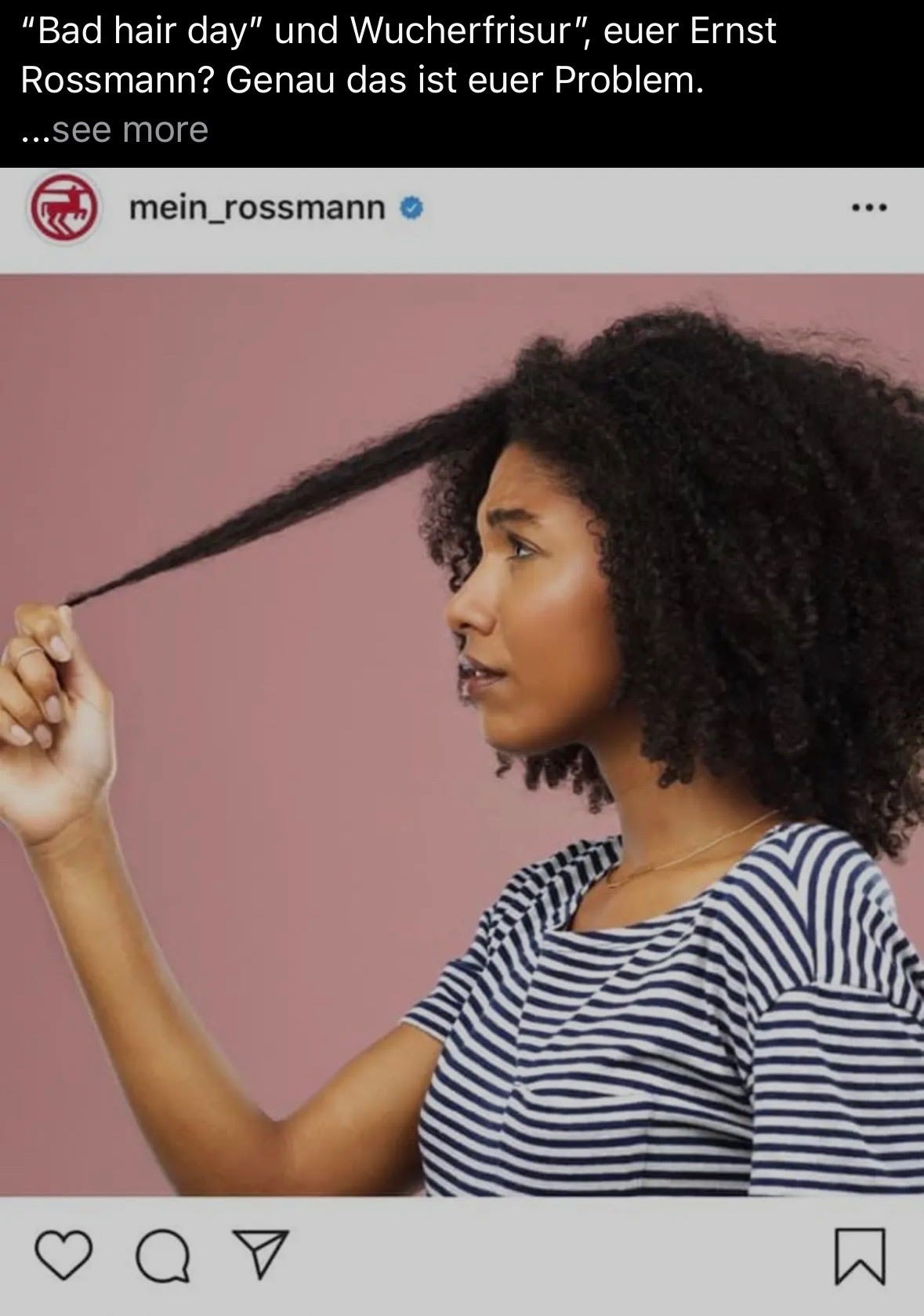
It comes back to: who is in decision-making positions? Who is choosing what products are stocked, what shades are available?
These are people in positions of power, and they likely don’t represent the full diversity of society.So they might think that the number of people needing darker shades or specific hair products is not significant enough. And what they’re doing is essentially cutting off a part of their potential customers without even realising the business opportunity they’re missing.
There has been some change, though. For example, brands like Cantu are becoming more available, like Afro Locke in these beauty providers. That’s been great progress.
And I think the internet has played a big role calling out these companies, creating visibility, and pushing for change.
But ultimately, it comes down to bias in decision-making.
I also feel that in Germany, even if it has taken a long time, we are starting to see some progress. For example, with Jacks Beauty line, which is a very big makeup German brand. They recently included a campaign with darker skin tones, which I find very interesting.
But at the same time, it leaves me with the feeling that, as people with darker skin tones, we almost feel grateful when a brand finally includes us.
And that makes me question why this is still happening. Does that mean there are no Black people working in these companies?
And more importantly: how can employees navigate and respond to working in environments like these?
Two things: The first is,, there’s not that many numbers about Black people in Germany. There’s the Afrozensus, which was created and came out in 2019. But other than that, it’s a sensitive thing to collect data about.
But nonetheless, that shouldn’t be the reason. You don’t have to have a survey from DM to be like, okay, there’s Black people living in this country. Let’s just test it. Let’s do some more market testing. Let’s get a range of shades without having to risk ourselves financially and see what’s going on see what the demand for that is.You know, test the demand.
As a Black employee, it shouldn’t have to be your responsibility to make them aware. You can raise awareness because it comes from your own need, but as a Black employee it shouldn’t be on your to-do list to be like, “Oh, listen to my white superiors most likely we’re lacking on this.”
And then you might get resistance. They might say, “It’s not enough,” or “It’s not…”you know, and then you receive pushback. And you’re left thinking, “This isn’t even my job.”
You know what I mean? I’m just telling you what I’m noticing and seeing on Instagram and on TikTok. Why are you not taking this seriously?
But it creates a lot of frustration. And that’s where you also see, you know, a higher turnover rate. People say, “You know what? I don’t even feel comfortable in this company anymore because my voice isn’t being heard and I keep being pushed down.” And they don’t want to stay, even though they know this is a reality that should be addressed.
What do you think are the historical or political origins of this?
It really has to do with the lack of acknowledgement. And it goes way back. I’m sorry I have to bring it to that, from beauty to colonization; but it has to do with the lack of acknowledging that Germany had colonies on the African continent. A lack of acknowledging that a lot of our population has a migrational background. A lack of acknowledging that Black people exist and come shopping in these stores.
It’s all a lack of acknowledgement that racism exists, and that this also a manifest. In a way, this is a form of racism it shows in how you’re not representing certain groups. Why not? People are here. Why are you only serving certain shades and not others? That’s why I personally used to avoid stores like DM or Rossmann and go to specialty shops instead. Or to MAC, where the full range existed but it was expensive. Over time, I’ve shifted again. I now go to Afro stores for hair products because they offer a wider range. For instance my mum, who is a dark skin woman, if I’m going to London or Paris, she expects me to bring her lipstick, makeup, foundation, because she just can’t find it here.
There’s still a lot to unpack there.
Germany is in some aspects, very behind.
Based on everything we’ve discussed, I want to ask you: what practical steps do you think companies can take to build inclusivity and make a lasting change?
The first step that companies can take is to look around and see who is sitting next to me, who are my peers, who are the decision-makers, and ask yourself: is there diversity here? what is our understanding of diversity?
So that’s the first thing, especially in a beauty company: creating that awareness.
Then, once you decide, “Okay, we have to become more representative,” it’s important to see this as a long-term process. It’s not something one-off . It also shouldn’t be treated as something isolated. It needs to be embedded across the organization.
For example, with Jack’s Beauty Line, it’s fantastic that they now have a more inclusive range. But when they are hosting an event and you look at the lineup again, where is the diversity there? Where is the representation? It’s still missing.
If a company truly wants to be diverse, inclusive, and representative throughout, it requires making decisions that might challenge the status quo. That might mean bringing in more diversity in visible ways whether that’s including people wearing hijabs, people with disabilities, or representing a broader spectrum of beauty.
You mentioned working on these issues in the long term. What kind of structure do you suggest?
One of the processes we recommend is starting with a diversity audit. Looking at what has already been done, how diversity has been measured, and what impact has been created so far. That provides a baseline.
From there, the next step is building awareness internally around these topics, especially regarding any lack of representation that may exist.
We also look at available data and research, or in some cases, where data is missing, we work with what is available to better understand the situation.
Then we move into different areas depending on the company’s needs. This could include: Leadership development and making leadership more inclusive.It can also extend into creative work. The goal is to ensure that every production or initiative whether it’s a workshop, an event, or a campaign is inclusive, rather than starting from zero each time.
The key point is that DEI should not be treated as a one-off project, but as an ongoing, continuous effort.